

UK Export Finance has recorded a “record” year thanks to the success of the General Export Facility (GEF), it has been revealed.
Author Archive: Muhammad Zia

What to consider when selling online
There has been a recent surge in online sellers and marketplaces over the last 12 months as businesses attempt to deal with the restrictions placed on everyday life by the Covid-19 pandemic.
Within the first four months of lockdown, more than 85,000 businesses launched online stores or joined online marketplaces.
Since then, many more have sprung up, as both new entrepreneurs enter the market and established businesses build successful e-commerce offerings.

Leaving your business in capable hands – Succession planning for the next generation
Many individuals who have spent their livelihoods building, running, and maintaining a successful business, often intend to pass on their accomplishments to a family member, a close relative or trusted employee.Continue reading

Government launches Shared Parental Leave and Pay portal for working families
A new online tool will make it easier for expecting parents to understand and plan statutory Shared Parental Leave and Pay, it has been revealed.Continue reading

Tax system overhaul – The Government’s response
Earlier this year, the House of Commons Treasury Select Committee released a new report called ‘Tax After Coronavirus’, which called for landmark changes to the UK’s tax system to deal with the impact of the COVID-19 pandemic.
This 80-page document was packed with recommendations for the Government to consider, put together and agreed by the cross-party group of MPs, which looked at how the nation could increase tax revenues without stunting economic growth.
Among the recommendations agreed by the Committee in its report were:
- Taxing Income from Work – Calls to reform this old, complex system and the interaction of different taxes, including greater alignment between Income Tax and National Insurance.
- Limited Companies – If the tax advantages of self-employment are to be reduced, then so should the tax advantages of operating through a limited company, relative to the taxation of employees, the report said.
- Digital Services Tax – The Committee said more work is needed in this area, and that it should be monitored to see the impact of the current levy on businesses and tax collection.
- Capital Gains and Inheritance Tax – These forms of taxation should be reformed and balanced with the need that any significant increase could damage future business investment in the UK, particularly in light of Brexit.
- Retail Sales Tax – The Committee said there is not enough evidence to support retail sales tax as an alternative to VAT and it could potentially be very complex given trade deals and how other jurisdictions would still charge VAT.
- Stamp Duty Land Tax – Described as economically inefficient and damaging to the economy and should be treated as a priority area for review so that the Government could set levels to encourage homeownership.
Whilst the Government does not have to act on these recommendations, it was given until May to provide an official response to this report – although elements of the recommendations were incorporated into the March Budget by the Chancellor.
However, the Government has now published its findings to the report in a response to the Treasury Committee.
Within its response, the Government said it is committed to supporting jobs, businesses and livelihoods.
It pointed to several measures undertaken already to support businesses based on the Committee’s recommendations, including:
- Extending the carry back rules from one to three years for both incorporated and unincorporated businesses.
- Creating additional capital allowances in the form of the super deduction and an extended first-year allowance, which it said went beyond the recommendations of the Committee to lengthen the current timeline for the £1 million Annual Investment Allowances beyond January 2022.
The Government said it had even gone further by extending a number of the existing support schemes, such as business rates relief and the VAT reduction for the UK’s tourism and hospitality sector, which were both linked to calls from the Treasury Committee in its report to continue helping businesses affected by the pandemic.
As a result of the Government’s actions over the past year and the measures announced at Budget, the Office for Budget Responsibility now expects the economy to return to its pre-crisis peak two quarters earlier than previously forecast.
Of course, in the original report, the Committee also called on the Government to maintain public spending at a sustainable level, which the Government claims it has done in its most recent actions.
In its statement to the Treasury Committee, the Government said: “The Chancellor has also been clear with taxpayers about the need to get the public finances back on track once the recovery is durably under way.
“The Budget also set out steps to repair the public finances once the recovery is well under way.”
The Government said in order to do this it would:
- Increase the main rate of Corporation Tax from 2026 under a new tapered system.
- Follow the recommendations of the original report to freeze personal taxes.
However, the latest response fell short on many of the major reforms to tax strategies laid out by the Committee, particular an overhaul of the Stamp Duty Land Tax and VAT systems.
The response stated: “The Budget has set out the Chancellor’s medium-term plan for how the tax system will support the Government’s broad economic objectives for the next five years.
“The Government keeps all taxes under review and the Chancellor will outline tax reforms as part of future fiscal events.”
Concluding the Government said it welcomed many of the recommendations made by the Committee, but felt that “the report leans away from measures that would help to repair the public finances in the coming years”.
The Government, while adopting some elements of the Committee’s ‘Tax After Coronavirus’ report, seem to have neglected or perhaps rejected other important elements as they focus more on economic growth instead of a major reform of UK taxation.
It is likely, however, that future Budgets will include measures that seek to recoup the significant spending brought about by COVID-19 and the subsequent recovery.
A full version of the Government’s response can be found here.
If you have any queries about the latest response or the measures recently outlined by the Government, please speak to our team today.

UK and Spain set to review Gibraltar tax residency agreement
The UK and Spain are set to review how residents and companies based in Gibraltar are treated for tax purposes in a bid to tackle tax avoidance, it has been announced.
It comes after the Joint Coordinating Committee and Liaison Body met last month to discuss tax co-operation between the authorities of Spain and Gibraltar, resulting in the International Agreement on Taxation and the Protection of Financial Interests regarding Gibraltar.
If you or your company has interests in either territory, here’s what you need to know.
What will the review look at?
According to reports, the review will largely look at tax co-operation between the authorities of Spain and Gibraltar, the tax residence criteria for people and companies, and new procedures for administrative cooperation.
Who will the new rules affect?
The new rules will affect taxpayers who have interests in both jurisdictions, such as those registered in Spain but have property or work in Gibraltar, or vice versa. This could have significant tax implications for those living in Gibraltar but are determined to be a tax resident in Spain.
According to the International Agreement, conflicts may arise when persons meet any of the following criteria:
- The person spends more than 183 overnight stays in Spanish territory;
- The spouse – or partner in a similar relationship – and/or economically dependent ascendants and descendants, have their habitual residence in Spain;
- The individual’s only permanent home is in Spain; or
- At least two-thirds of the individual’s net assets are located in Spain.
In addition, Spanish nationals who transferred their residence to Gibraltar after 4 March 2019 will only be considered a tax resident in Spain.
Rules for companies
The review will also affect companies incorporated and managed in Gibraltar, where any of the following apply:
- Most of their assets are located, or most of their rights are enforceable, in Spanish territory;
- Most of their income is Spanish-sourced;
- Most of the people in charge of effective management are tax residents in Spain; or
- Residents of Spain politically or financially control the company, entity, or other legal form.
Provisions to take effect from the start of the next tax year
The provisions agreed in the international agreement will not come into effect until the next tax year. This means 1 July 2021 for Gibraltar and 1 January 2022 for Spain.
Get expert advice today
For help and advice with related matters, please get in touch with our team today.

Over half of Brits plan to shop with small and local businesses after pandemic, study reveals
Around half of Brits plan to spend their money with small and local businesses in the wake of the coronavirus pandemic, a major study has revealed.

Get ready for the next stages of Making Tax Digital
From 6 April 2023, Making Tax Digital (MTD) initiative is being expanded to include businesses and landlords with a combined total gross income over £10,000 per annum, from the following sources:
- Income from self-employment
- Income from partnership
- Income from UK property
- Income from overseas property
However, there are exceptions, including:
- Trusts, estates, trustees of registered pension schemes and non-resident companies
- Partnerships that have corporate partners and Limited Liability Partnerships are not required to join MTD for Income Tax in April 2023 but will be required to join MTD at a future date.
Under these changes, you will be required to keep digital business records of all your business income and expenses, including income from self-employment or property, at a transaction level.
You will then be required to use MTD compatible software to send updates to HMRC every quarter.
This will mean that there will now be five ‘returns’ a year instead of just one self-assessment tax return.
The deadline for quarterly summary tax information must be with HMRC one month following the quarter-end.
At the end of the tax year, there will then be a final declaration made to HMRC to include details of all other income and any accounting adjustments.
You must submit your final declaration and pay the tax you owe by 31 January the following tax year.
Making Tax Digital for Corporation Tax
A consultation is currently being carried out by HMRC to explore how the core principles of MTD can be applied to Corporation Tax (CT).
Within the consultation document, HMRC made it clear that MTD for CT is a means of tackling the underpayment of tax, especially amongst smaller businesses, where HMRC believes these are significant issues with errors.
The tax authority has indicated that as much as £2.1billion of the tax gap relates to CT.
Along similar lines to the existing MTD for VAT system, the proposals put forward a process that would require companies to maintain their records digitally and the submission of quarterly updates and a year-end tax return using MTD compatible software.
These quarterly submissions will focus on accounting data, with the option of including indicative changes to tax treatment. However, the usual annual tax return will be retained to allow HMRC to take a final decision on tax treatment.
These changes, if implemented, will affect the majority of businesses. Under the current proposals, it will be necessary to link accounting data directly to the tax return submission for all businesses.
HMRC has indicated that it intends to hold a voluntary pilot from April 2024 to test the effectiveness of the system, before rolling it out more widely by 2026 at the earliest.
It is important that businesses prepare themselves for future changes and that VAT-registered businesses continue to comply with the current digital tax rules.
This includes using the correct online accounting software and processes that are compliant with the ever-changing MTD regime.
MTD Penalties
Business owners need to be aware that HMRC’s so-called ‘soft landing’ period for Making Tax Digital (MTD) came to an end recently.
When MTD first came into force in 2019, HMRC allowed businesses additional time to put in place digital links.
The soft landing was due to come to an end in April 2020 but was extended to April 2021 as a result of Covid-19.
From now on, HMRC will issue penalties for not keeping complete and ‘adequate’ digital records for VAT returns each quarter – which means that copying and pasting data from a spreadsheet is no longer sufficient in most cases.
From 1 April 2022, MTD will also apply to all VAT registered businesses for their VAT obligations, including those that are voluntarily registered with a taxable turnover below the VAT threshold (£85,000).
Need further advice?
 |
 |
|
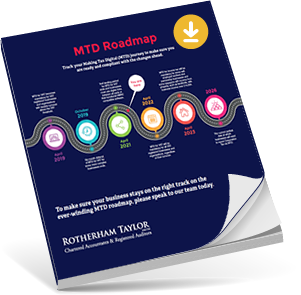
| Download our helpful MTD Roadmap infographic | Click here to download our Guide to MTD |
If you would like help preparing for MTD or are struggling with the complexities of the current VAT regime, please contact us.

Could diversification help you adapt to changing commercial realities?
You cannot take an effective business model off the shelf and use it as some sort of ready-made formula for success. Nor can you assume that a business model that has been effective in the past will continue to be now or in the future.
That is because a business model can only ever be effective in relation to its context.

What are the benefits of running a side business?
With the effects of the coronavirus pandemic leaving many people short on funding, some have turned to side businesses to provide them with extra funds to make up for their financial losses. Continue reading